We've been getting lots of rain lately here in the Rio Grande Valley of south Texas lately so I thought I would make a short trip out to west Texas to escape for a few days while things dry out. They were getting some rain out there also and it was a bit cooler than the usual summertime hellishness. Also I had recently come across striking photos on iNaturalist of a couple of red eyed digger bee species that looked unreal so that would give me something to look for besides the usual birds and butterflies.
Well as it turned out the rain followed me. I raced up though Laredo and Del Rio and finally made a bugging stop at the big bridge over the Pecos River. But it was still raining and I saw little, though things looked pretty good. My target Dotted Checkerspot was nowhere to be seen though its Penstemon host plant was blooming. I wonder if after a couple of years of no rain, the little population of Dotted Checkerspots might be extirpated.
My next stop was Judge Roy Bean visitors center in Langtry where I have been coming since I was a kid. In fact my first visit was on a family vacation in 1967. They have a nice little butterfly garden along with the trail through the cactus garden. The sky brightened a little and butterflies were out. This striking Great Purple Hairstreak rested on a sotol. They use mistletoe as a host plant.
There were a dozen species out but nothing else exciting so I moved on. Rain continued and I tried a new restaurant in Sanderson that turned out to make a really good green chili cheeseburger. That last few times I had passed through there were no restaurants open so this was a nice find. The sun finally popped out in late afternoon as I reached the Brewster County line. There was a line of brush with blooming white brush along the highway but surprisingly few butterflies. But there were digger bees! First it was the common California Digger Bee feeding on bee balm.
Then there was a Centris. I was hoping for red eyes but it was not to be. The zigzag black border above the yellow clypeus indicates a female Centis atripes, our common oil digger in the Valley. The eyes do have a slightly liver colored tinge. I wonder if that means anything.
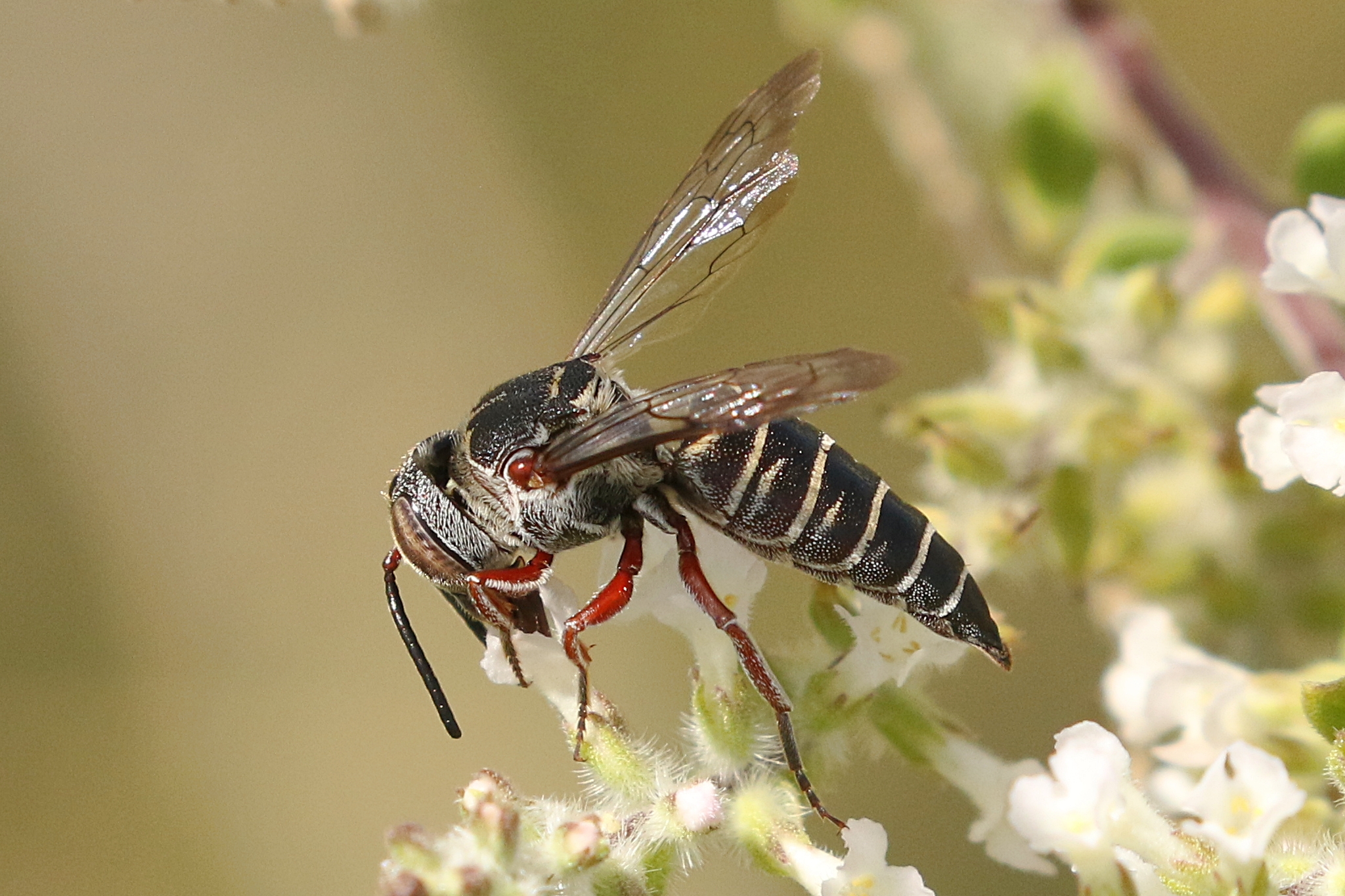
The major find at this spot was this strange leaf cutter bee. I can find nothing like it on iNat. The markings on the thorax are similar to those of Megachile sidalceae but I think this is a female and there are only photos of males on iNat. Of course it may not even be a Megachile.
I spent the night in Alpine where it rained like crazy. This turned out to be part of the same system that caused the terrible death and destruction in the Hill Country the morning of July 4. But I was completely unaware as I enjoyed a sunny morning while I made the eighty mile drive to Big Bend. These Scimitar-horned Oryx were a surprise south of Elephant Mountain. Once declared extinct in the wilds of Subsaharan Africa these huge antelope have proved easy to breed and are numerous on Texas game ranches.
When I reached the entrance to Big Bend National Park I was disappointed to learn all the back country dirt roads were closed due to the previous night's heavy rain. So I made the best of it along the paved tour roads. A stop at the usually productive Sam Nail Ranch turned up my first of many Palmer's Metalmarks.
And a striking Greater Earless Lizard.
I found some more of the strongly marged Megachile, both male and female. Well I guess they are Megachile. I wish I could have gotten a better shot of what seems to be a modified foreleg on the male.
My big find was this Coyote Cloudywing. This species is fairly common in the western portions of the RGV and I was not really surprised to find it. But upon doing my iNaturalist entries I discovered it ws a first for Big Bend and Brewster County.
No red-eyed digger bees so I moved on up towards the Basin. It was warming up but still pleasant compared to the normal Big Bend summer hell. The basin was crouded with 4th of July tourists but not as bad as usual as the Lodge is closed to prepare for the big construction next year of a new lodge. I bet it will be expensive. A blooming thistle produced my lifer Lithurgopsis apicalis. Looks like our local littoralis from the RGV but has ornage hairs on the tip of the abdomen.
A walk up behind the lodge produce the usual Arizona Sister. The Two-tailed Swallowtail would not cooperate.
And my first Marine Blue for the trip.
But not a lot else so I moved back down the mountain, stopping in the chapparal to get this great Glorious Protoxeae. Turned out to be only the second record for the Park on iNat.
Thinking the garden at the Visitors Center might be blooming I headed on down to Panther Gulch. The blooming white brush was covered with Lyside Sulphurs but it was this little Coelioxys cuckoo bee that got my attention. This stocky male looks like what I have been calling edita in the Valley. I'm entering it as Xerocoelioxys subspecies on iNat. There are a handful of what seems to be this same taxon scattered across west Texas. Too bad the bee biologists only collect specimens and do not photograph live bees. Collecting is easier. Used to be birds could only be identified after being shot with a fowling piece. But Ludlow Griscom discoved you could ID them through binoculars. Jeff Glassberg did the same for butterfly identification. Now it's time for bees.


Not much else exciting so I droved over to Study Butte to get my humble but overpriced room at the Chisos Mining Company Motel. Considering how overpriced everything is at Big Bend, at $90 it's not a bad deal. I was happy to find a new restaurant, The Chili Pepper Cafe, which proved to be really good and reasonably priced. The locals need a place to eat.
Then next morning I was back in the Park and looking for red eyed bees. There are two species of Centris digger bees with red eyes. and a number of photos showed them feeding on creosote flowers. And some of the creosote was blooming so I started looking. It didn't take long. This is the Red-Legged Oil Digger Bee Centris rhodopus.
Nearby was a large female Glorious Protoxeae. This species proved to be more numerous than indicated on iNat.
A few miles down the road I found my first Dury's Metalmark. This species has been split from Mormon Metalmark. This is the first iNat record for the year at Big Bend.
I enjoyed the desert plants along the way but didn't see many more butterflies till I reached the Panther Junction visitors center. The white brush was again alive with pollinators, 90 percent of which were Lyside Sulphurs.
There were more Dury's Metalmarks.
And probably a dozen more Palmer's Metalmarks.
A cooperative female leafcutter cuckoo bee sure looked like the Coelioxys texanus I see in the Valley.

Not much else exciting so I headed back west down the main road. A trip back up to the Basin with a walk up to the cabins turned up little. So I returned to the main road and continued west. At the junction with Grapevine Hills Road I saw some accessible esperanza, Tecoma stans. In the RGV esperanza attracts both butterflies and bees so I thought I should check them out. But an oil digger bee got my attention. It was what I am calling a female Centris atripes based on the dark zigzag edge of the yellow clypeus though they are a bit rusty eyed and darker headed than those in the Valley.
Then in a nearby white brush this red eyed one popped up. It was another Centris rhodopus! Only the females have the red eyes so two female Centris species were within feet of each other.
Despite not being able to do my hike up Pine Canyon, I still called it a pretty good day and made my way back to Study Butte and another meal at the Chili Pepper Cafe.
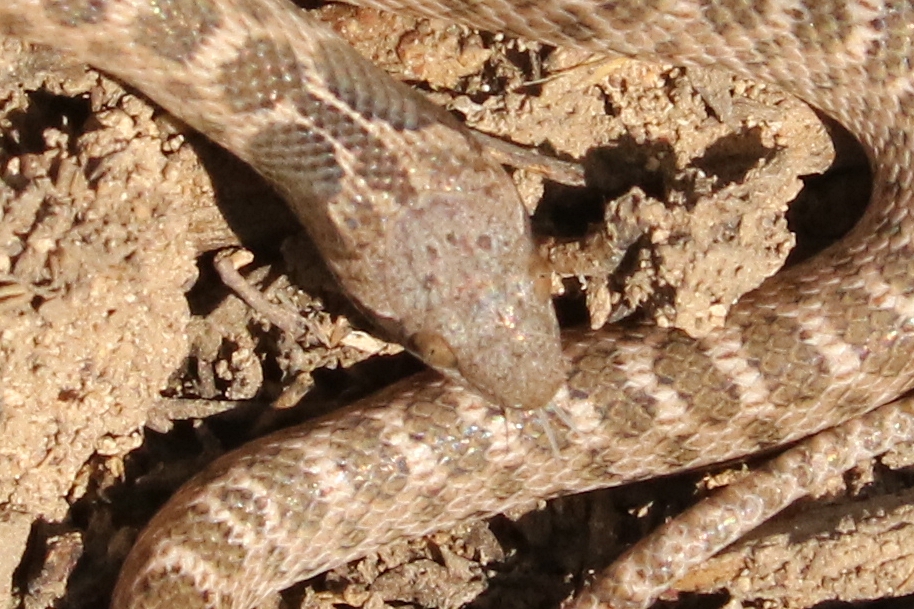
The following morning I needed to decide whether to go up into the Davis Mountains or head for home. The Davis Mountains Preserve are having another open house in August so I might come back then. So I liesurely headed for home checking out flowers along the way. Nothing exciting at the first couple of stops. Then while walking along a mostly barren road side I stopped to turn over a piece of wood hoping for bugs underneath. The small Texas Night Snake underneath has to be the critter of the trip. This is one of the slightly venemous rear fanged snakes of the family Colubridae. I should have grabbed it to get a pic of the vertical pupils but I didn't want to bother it. I'm not a very good herper. They grab first and ask questions later.


The desert grasslands have been having a good summer. I spotted a nornally dry crossing that was holding water and surrounded by lush grass. There were dragonflies but not much in the way of butterflies. Then while walking back to the jeep I saw a good sized buffy bee with a black abdomen. Were those red eyes? Yes, bright red eyes! My first Cesalpinia Oil-Digger Bee!
About the only thing noteworthy at the next few stops were a few Tiny Checkerspots. They are not common in Texas.
A few more stops did not produce a lot of exciting bugs. And I'm tired of writing. I need to get out now locally and see if the summer rains have produced any good bugs.


.JPG)